For the best part of a decade, the drinks industry has leaned on one tidy story to explain itself. People are drinking less, the line goes, but when they do drink they spend more, reaching past the everyday bottle for something better. “Less but better” became the slogan that justified premium launches, prestige extensions and the steady march up the price ladder. The question now, with household budgets under real strain, is whether that story still holds. Looking at the latest IWSR UK spirits data, the honest answer is that it no longer holds cleanly. Premiumisation has not gone into reverse, but it has been hollowed out.
The shrinking pie
Start with the backdrop, because it matters. Total UK spirits volume fell from roughly 40.3 million nine-litre cases in 2021 to around 34.0 million in 2025, a decline of close to 16 percent, with a further 3.8 percent lost in the most recent year alone. This is a market under pressure on every front, squeezed by cost-of-living concerns, duty increases, wider moderation and even the early impact of weight-loss drugs. Consumers, as IWSR puts it, are still engaging with the category but have become more “choiceful” and price sensitive.
So the real question is not whether people are drinking less. They clearly are. The question is what happens to the mix as the pie shrinks. If premiumisation were still working in its classic form, the upper price bands would be holding their ground or growing share while the cheaper tiers fell away. That is not quite what the data shows.
A barbell, with a sagging middle
Break the market into its price bands and a more interesting picture emerges. The very top of the market is genuinely resilient. The Ultra-Premium tier was essentially flat over the four years, down just 1.5 percent against a market that fell almost 16 percent, and it actually grew in the latest year while nearly everything else declined. The tiny Prestige-Plus band, the rarefied stuff above 266 pounds a bottle, grew by 12 percent. Trading up, in other words, is alive at the apex.
The problem is what sits just below. The Premium band, the first real step up from the mainstream, was the single worst performer of the lot, down almost 20 percent. This is the rung that powered the broad-based premiumisation of the 2010s, the accessible “treat” purchase that took shoppers a notch above standard. It is now being squeezed harder than any other part of the market, and it lost more share than any other band.
Where did that volume go? Not, for the most part, to the bottom. The Value tier also lost share. Instead, volume consolidated into the mainstream. Standard spirits, which already account for around two-thirds of the market, were the only band to gain share at all, rising from 64.7 percent in 2021 to 65.4 percent in 2025. Shoppers are not crashing to the cheapest shelf. They are retreating to the safe, familiar middle, the big trusted brands at everyday prices.
The shape of all this is a barbell with a sagging centre. A resilient luxury apex, a squeezed premium step-up tier, and a thickening mainstream core. The simple upward escalator of the last decade has stalled.
UK spirits volume change by price band, 2021 to 2025
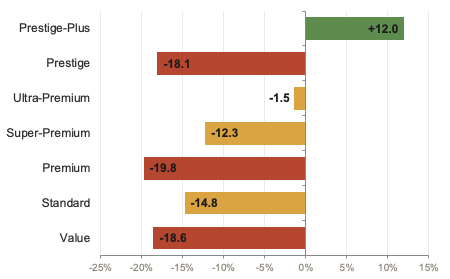
Volume in 000s 9-litre cases. Source: IWSR UK Spirits 2026, Spirits Price Band Analysis.
What the categories confirm
The category detail tells the same story. In Scotch, blended premium-and-above volumes fell by 23 percent, and what growth there was in malts is described as “value-driven”, with drinkers explicitly “not trading up into aged products”. In Irish whiskey, Jameson grew at a mainstream price point while ultra-premium-and-above fell by more than 20 percent. Cognac shows a textbook barbell, with consumers “trading up into XO brandies and down from Cognac”, alongside a forecast shift from VSOP to cheaper VS. Across the board the pattern repeats, with promotions, discounters, own-label lines, litre bottles and smaller fractional formats all gaining ground as people manage their spend.
There are real exceptions, and they are worth knowing. Agave spirits are the standout, with Ultra-Premium tequila volumes more than doubling since 2021 and Super-Premium roughly doubling. Premium gold and sipping rums continue to climb, and high-strength RTDs are pulling drinkers in with the promise of more bang for the buck. These are genuine premiumisation stories. But they are momentum categories swimming against the tide, not evidence that the tide itself is still rising.
So, is it still happening?
The fairest reading is this. Premiumisation has not collapsed into wholesale downtrading. The luxury apex is holding, a handful of categories are genuinely trading up, and the cheapest tier is not gaining either. But the broad, middle-class trade-up that defined the 2010s has stalled. The premium step-up tier is shrinking fastest, volume is consolidating into the mainstream, and a good deal of the value growth on the surface is price inflation wearing premiumisation’s clothes.
For brands, the implication is sharper than the old slogan allowed. “Less but better” has narrowed to “less, and better only at the very top or in the categories with real cultural momentum”. Everywhere else, the smart money is on the resilient mainstream, on promotions that protect rate of sale, and on giving cautious consumers a reason to stay rather than assuming they will keep climbing.